From Pilot to Product: What Makes Startup–Corporate Collaboration Work in Agriculture
Agriculture enters 2026 with a sharper focus on outcomes. Investors, growers and corporates are converging on the same expectations: predictable performance, capital efficiency, clear route to market, and evidence that holds up in real conditions. Across the agri‑tech ecosystem, leading corporates, investors, and growers increasingly prioritize solutions that deliver measurable ROI, reduce operational risk, and integrate into existing workflows.
In this environment, the question is no longer whether startups and corporates should collaborate. The question is how to structure these partnerships so they produce real deployment, not prolonged experimentation.
Why Pilots Stall
Many collaborations begin with enthusiasm but lose momentum because the partners never established a shared definition of success. Pilots often become demonstrations rather than tests and may lack the replication or environmental diversity required to create confidence for product level performance and scale. The market has become more selective. Investors are rewarding companies that prove value early and in real‑world conditions, not those that extend pilots indefinitely.
This shift aligns with a broader recalibration in agri‑tech. Capital availability has tightened, growers emphasize solutions that increase productivity per acre within two seasons, and incumbents are more deliberate about partnerships and acquisitions. Resilience is linked to pragmatism. Evidence now matters more than novelty.
Start With an Evidence Bar
Successful collaborations begin by defining what good looks like before the field work begins. Five components consistently matter:
- Technical performance that replicates across environments rather than excelling only in isolated locations.
- Economic viability that demonstrates the technology can scale with a sustainable cost structure.
- A realistic regulatory pathway with timelines aligned to both collaborators’ strategic horizons.
- Integration fit with existing equipment, data flows, and farmer workflows so that adoption does not increase operational complexity.
- Farmer value that can be realized within one to two seasons, aligning to current budget and risk constraints on the farm.
This type of clarity allows both parties to determine whether the effort should be co‑development, validation, or scaling.
Match the Engagement Model to the Stage
There is no single template for startup–corporate collaboration. The most productive relationships typically fall into three patterns.
- Co‑development is suited for technologies that are promising but early. The startup brings speed, focus, and foundational innovation. The corporate contributes scientific depth, field networks, regulatory or manufacturing expertise, and a clearer route to market.
- Pilot and validate is appropriate when a product is nearing readiness but requires multi‑environment, multi‑season confirmation. This is common in biologicals, automation and precision tools where variability can be high and growers are sensitive to risk.
- Partner and scale works when the technology already demonstrates product‑market fit. In this case the constraint is not evidence but channel reach, support or global deployment. The work shifts from technical validation to operational enablement.
What Founders Can Do Now
Founders can accelerate credibility by bringing a solid pitch deck supported by data to early conversations. Their presentation should describe their proprietary technology, its uniqueness compared with alternatives, and its intellectual property underpinnings. It should describe prior achievements and proof points, define success metrics, replication strategies, and required resources. Depending on technology and to demonstrate thoughtfulness, founders should concern themselves with regulatory or manufacturing dependencies and assume an adoption model that is realistic for growers who make decisions under time, cost, and labor constraints.
What Corporates Can Do Now
Corporates can reduce friction by publishing problem statements, providing sample data, and examples of successful engagement pathways. Assigning a joint project management structure responsible for coordinating, evaluating, and decision-making helps maintain momentum. A solid science plan and pre‑aligned routes for co‑development, validation, and scaling enable teams to act when the data supports a decision.
Why This Matters
The sector is moving from experimentation toward execution. The collaborations that will define the next decade are those where partners combine scientific rigor, commercial realism, and transparent decision making. When both sides commit to shared evidence, time‑bound decisions and operational clarity, pilots become products and innovation becomes impact.
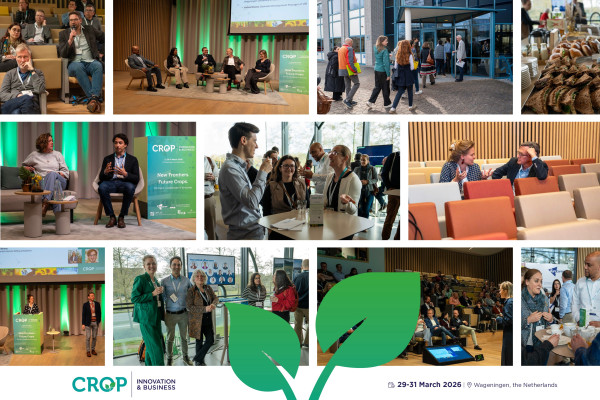
Tom Greene contributes to industry dialogues on how evidence, scientific rigor, and practical pathways to deployment shape successful agricultural innovation. His work leading Corteva Catalyst™ centers on evaluating emerging technologies and guiding structured partnership models. He and his colleague Mat Müller will be featured speakers at CropIB 2026, with Tom addressing collaboration and innovation strategy and Mat speaking on advanced biotechnology while serving on the event’s Program Committee.